
Casinos That Accept Visa in the UK: What to Check
 Available in GB
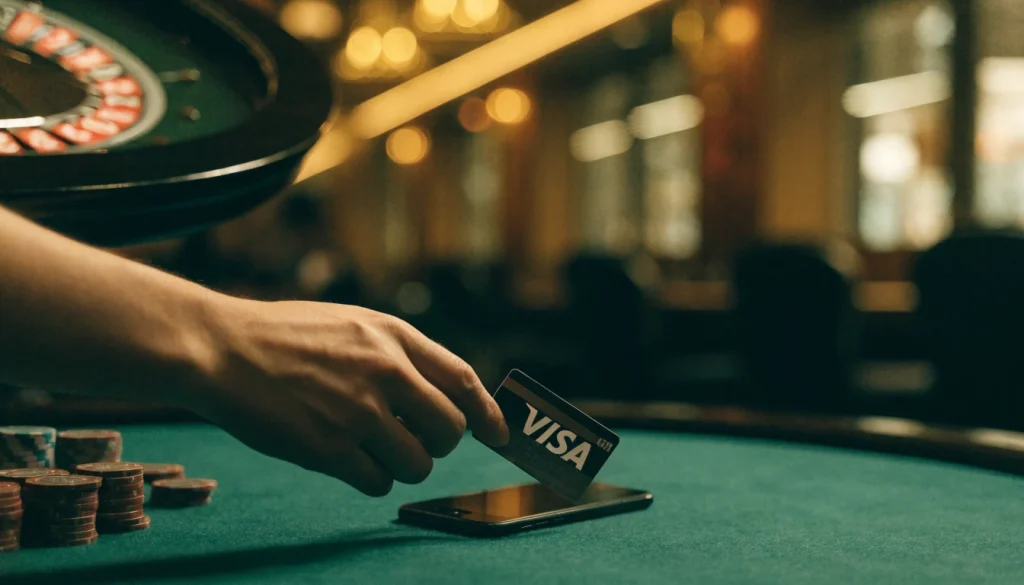
Visa availability depends on the casino cashier and eligible card product, while withdrawal routes and account limits remain separate considerations.
Visa at Online Casinos: What the Cashier Actually Confirms
Visa is commonly accepted at UK online casinos as a debit-card payment method. That is a useful starting point, but “accepts Visa” is not a blanket promise that every Visa-branded card will work at every casino. The practical answer belongs to the individual casino’s cashier, where the available methods and eligible card products are shown for the account.
I separate the broad payment label from the actual option presented at checkout. A site may list Visa alongside Mastercard in a general payment summary, while its cashier is the place to confirm whether Visa is currently available for a UK account. The distinction matters: a logo is a signpost, not a completed compatibility check.
What “accepts Visa” means
In ordinary use, the phrase means that the casino offers a Visa debit route for an eligible customer and card product. It does not mean that the method is guaranteed to appear for every account, or that every card carrying the Visa name is necessarily eligible. The cashier is the operational record of what can be selected at that point.
When choosing a UK casino that accepts Visa, check the payment details that matter to you before signing up. This list provides a concise reference for the operators, including the payout information available for each.
1. NightLuck
Payout speed: 1-3 business days
NightLuck lists a payout speed of 1–3 business days.
2. BeOnBet
Payout speed: 1-3 business days
BeOnBet lists a payout speed of 1–3 business days.
3. EvoSpin
Payout speed: 1-3 business days
EvoSpin lists a payout speed of 1–3 business days.
4. Zombillion
Payout speed: 1-3 business days
Zombillion lists a payout speed of 1–3 business days.
5. NightWin
Payout speed: 1-3 business days
NightWin lists a payout speed of 1–3 business days.
6. Jetsetspins
Payout speed: 1-3 business days
Jetsetspins lists a payout speed of 1–3 business days.
7. Revery Play
Payout speed: 1-3 business days
Revery Play lists a payout speed of 1–3 business days.
8. SpinFormula
Payout speed: 1-3 business days
SpinFormula lists a payout speed of 1–3 business days.
9. Britsino
Payout speed: 1-3 business days
Britsino lists a payout speed of 1–3 business days.
10. SlotoSport
Payout speed: 1-3 business days
SlotoSport lists a payout speed of 1–3 business days.
A specialist review may list Visa and Mastercard among a casino’s payment methods. That description can help identify sites worth checking, but it cannot confirm current UK availability or the eligibility of a particular card product. Those details need to be established in the cashier itself. Payment information can be presented at different levels of generality; only the final payment menu shows the option relevant to the account.
This is why a list of casinos that accept Visa should be read as a starting point rather than as a definitive inventory of working cards. If Visa appears as a selectable method, that is more meaningful than a logo elsewhere on the site. If it does not appear, the general payment page does not override the cashier.
The debit-card distinction
For UK casino payments, the relevant Visa route is debit. UK casinos commonly accept debit cards, including Visa and Mastercard. The word “Visa” alone, however, identifies a card network, not necessarily the precise product or payment route being offered. The cashier’s wording and available choices establish what the casino is asking to use.
That makes “Visa casino” a shorthand, not a complete description. A casino account may have a payment page mentioning Visa, but the actual confirmation comes when the cashier presents Visa as an available option for that account and card product. The distinction is plain but important. A displayed brand is not the same thing as an available transaction route.
Casinos That Accept WebMoney in the UK: What’s Verified
I treat the cashier as the point where a general claim becomes specific. It shows whether Visa is offered in the current payment flow, rather than merely mentioned in marketing or in a third-party description. That is the answer to the basic question of whether a casino takes Visa: the method must be available in that casino’s own payment interface.
What it does not confirm
A Visa option confirms only the payment method presented in the cashier. It does not, by itself, establish that a particular bonus applies, that every casino game can be funded in the same way, or that the casino’s wider account conditions are identical across customers. Those are separate terms, not consequences of seeing a card logo.
The same caution applies to phrases such as “Visa slots” or “slots with Visa”. They describe a search for casinos where a Visa debit route can be used to fund an account, not a special category of slot game. Visa is a payment method; it does not identify the games available or alter how a game operates.
Nor does the presence of Visa settle whether an account is suitable for a particular player. It tells nothing by itself about account status or the operator’s regulatory position. For the British market, real-money remote gambling operators serving customers must hold the relevant UK Gambling Commission licence. Payment branding is not a substitute for that regulatory check.
The useful reading is therefore narrow: UK casinos commonly accept Visa debit, but acceptance means that the casino’s cashier offers the method for an eligible card product at the time of use. A broad payment list can point towards that possibility; it cannot confirm it for an individual account. The cashier does.
A logo on a website is a signpost, not a completed compatibility check; only the casino’s cashier can confirm if Visa is currently available for a specific UK account.
Visa Deposits, Minimums and Account Limits
A Visa deposit has two separate thresholds: the smallest amount the cashier will accept in one transaction, and the largest amount it will permit. Neither is a fixed feature of the Visa brand. Casinos set their own payment conditions, and the figures can differ between payment methods even within the same account.
A specialist review reports minimum deposits in the £10–£20 range, depending on the selected method. That is a guide to what may be advertised, not a promise that every Visa cashier uses either figure. The amount shown at the point of payment is the relevant one: it reflects the casino’s current settings for that method. A minimum may also change if the deposit route changes, so a figure seen beside another payment option should not be assumed to apply to Visa.
The distinction matters in practice. A cashier can reject a deposit that falls below its stated minimum even when the card is otherwise eligible. Equally, a minimum is only an entry threshold; it says nothing about how much the account can deposit in total. The two figures serve different purposes. One governs a single attempted payment, while the other may be shaped by broader transaction or account controls.
Three kinds of maximum
Deposit caps may be set per transaction, per day or per month. These are not interchangeable. A per-transaction ceiling concerns one payment; a daily or monthly ceiling concerns the total deposited across the relevant period. A casino can therefore allow a deposit that is below the single-payment maximum while still preventing it because the account has reached a wider cap.
Casinos that accept Solana in the UK: payment facts
A specialist review notes that maximum deposit limits vary with both the payment method and account status. The practical result is that a published limit can be less informative than the figure available to a particular customer in the cashier. The selected method may have its own ceiling, while the account may also be subject to a separate restriction. Where those controls overlap, the lower applicable limit determines what can go through.
This is why a general statement such as “Visa deposits accepted” does not answer the amount question. It establishes neither the minimum nor the available headroom. Those details belong to the deposit screen and account conditions, not to the payment logo.
Why limits can differ
Payment methods do not all use the same processing arrangements, so casinos can attach different minimums and maximums to them. Account status is another variable. The limit displayed for one account may not be the limit available to another, and a figure stated in general payment information may not describe the current position of an individual account.
From the operator’s side, these are controls around how much money may enter through a particular route and how much may be deposited overall. From the player’s side, they can look like one unexplained refusal unless the cashier separates the per-payment cap from the account-level restriction. A declined amount does not necessarily mean the card has failed; it may simply exceed a limit that applies at that moment.
The wording on the cashier matters. “Maximum per transaction” should not be read as a daily allowance, and a daily cap should not be treated as a monthly one. If the screen only presents a single figure, it may be necessary to consult the payment terms to understand which cap it describes. Guessing from a previous deposit is unreliable because the available limit can depend on method and account status.
Per-transaction Ceiling
A limit concerning a single attempted payment.
Daily Ceiling
A limit on the total amount deposited across one day.
Monthly Ceiling
A limit on the total amount deposited across one month.
Reading the amount before confirming
The useful comparison is not between a casino’s headline minimum and a competitor’s headline minimum. It is between the amount required for the intended Visa transaction and the minimum and maximum actually shown for that account. A small advertised minimum does not guarantee that every larger amount will be accepted, just as a high transaction ceiling does not remove a separate daily or monthly cap.
I have seen payment conditions treated as decoration around the cashier. They are not. The cashier is where the amount rules become operational: a minimum can block a smaller payment, and a cap can stop a larger one. The displayed terms are the working boundary.
For a Visa deposit, the key figures are therefore the method’s minimum, its per-transaction maximum and any broader account limits. Those figures can vary; they should be read as separate controls rather than collapsed into one deposit limit. No fixed amount can be carried across every casino or every account.
Ukash Casinos in the UK: What Payment Options Remain
Why Visa Availability Can Differ Between Online Casinos
A Visa logo answers a narrow question: the operator lists Visa among its payment methods. It does not confirm that every UK customer can use every Visa card at that casino. I treat the cashier, rather than a general payment-page statement, as the practical check because that is where the operator displays the options available for the account and the card details being entered.
The distinction matters because “Visa accepted” can describe a payment method at site level, not a universal promise about individual transactions. A specialist review may list Visa and Mastercard after checking a casino’s published information, but current UK availability and eligibility for a particular card product still need to be confirmed in the cashier. The published logo is a starting point. Not the final word.
Compatibility can depend on the casino’s current payment setup and on whether the card product is eligible. Those conditions may not be obvious from a banner, a footer logo or a broad statement that the site takes Visa. Even within the same brand, payment choices can be presented after account sign-in, so a public page may not show the full picture. A card that is valid for ordinary online purchases is not, by that fact alone, confirmed as usable at a particular casino.
Casinos That Accept POLi in the UK: How to Check
The same care applies to claims about casinos that “pay out to Visa”. A deposit option and a withdrawal route are separate questions; seeing Visa at the deposit stage does not settle how funds can be returned. That distinction belongs to the cashier’s current options and the operator’s payment terms, not to the logo itself.
There is also a currency check. A specialist review may state that a casino supports GBP, but the account currency should be confirmed before the first transaction. A site can display a payment method while the account is set to a different currency, leaving conversion relevant to the transaction. The currency shown in the account is more useful than an assumption based on the casino serving the UK.
When comparing casinos, I look for a sequence rather than a label: the cashier offers Visa for the account, the card product is eligible, and the account currency is suitable. If one point is unclear, the logo cannot fill the gap. Payment pages can be useful for narrowing down options, but they are not a substitute for the live cashier.
Casinos That Accept AstroPay in the UK: What to Check
This also explains why a single list of Visa casinos can age quickly or overstate what it proves. A listing can show that Visa appears in a site’s published payment information; it cannot establish that the same option is available to every UK customer or card product at the time of use. The live display is the more precise evidence.
In practice, acceptance is conditional, not a blanket feature attached to every Visa card. I have seen how easily a short payment label gets read as a guarantee. It is only an indication. The cashier confirms the actual route.
Visa Debit Is Not Visa Credit for Gambling
“Visa accepted” can describe two different card products. Visa is the payment network; debit and credit describe how the card account is funded. A Visa debit card draws on money held in the linked bank account, while a Visa credit card uses borrowing from the card issuer. The logo alone does not settle the distinction.
Casinos That Accept USDC in the UK
That matters because UK-licensed casinos commonly accept debit cards, including Visa and Mastercard, but credit-card payments for gambling are prohibited. The regulator introduced the ban on 14 April 2020, and it has not been relaxed. So a statement that a casino accepts Visa should not be read as permission to fund gambling with any Visa-branded card.
In my experience, payment wording can compress several separate checks into a short label. The brand identifies the network; the card product determines whether the payment falls within the permitted category. A Visa debit card and a Visa credit card may look similar in a wallet, but they do not have the same status for gambling payments. The distinction is substantive, not cosmetic.
The rule applies to the source of funds, not merely to the route shown on screen. UK remote gambling operators cannot accept credit-card payments for gambling, including credit-card funding routed through a money service business. Nor can they accept wallet payments where the wallet allows credit-card funds to be used for gambling. Moving the payment through another service does not turn credit into debit.
Casinos That Accept Wirecard in the UK: What to Check
This is why “Visa payments” is less precise than “Visa debit”. A broad payment-method label may tell nothing about which card product is eligible, and it cannot override the restriction. For a UK-licensed casino, the permitted card route is debit, not credit. The rule is about the funding mechanism, not whether the transaction is made on a desktop or mobile device.
The distinction also helps explain why a payment can fail even when a casino lists Visa as an option. The network name is not proof that a particular card is a debit product or that it can be used for gambling. Operators have to apply the credit-card restriction, rather than treating every card with the same logo alike. A broad acceptance claim is not a loophole.
There is a practical difference between a card that spends funds already in an account and one that creates a debt to the issuer. The latter remains credit-card gambling even if the payment appears as a standard card transaction or passes through an intermediary. What matters is the underlying funding source.
Credit Card Ban
Credit-card payments for gambling are prohibited for UK-licensed casinos; only Visa debit is permitted.
So, when a casino says it accepts Visa, the meaningful question is whether it accepts Visa debit for gambling. Credit is outside the permitted boundary. Clear labels matter. The logo is not the rule.
Visa Deposits and the Rules for Online Slots
A Visa deposit and an online slot are governed by different parts of the transaction. The card is a way to fund a gambling account; it does not determine which games are available or how a slot may be played. UK casinos commonly accept debit cards, including Visa and Mastercard, but that payment route does not change the rules attached to online slots.
That distinction matters when a casino promotes itself as a place to play slots with Visa. The wording can make the payment method sound like a feature of the games. It is not. A slot’s stake rules, spin speed and permitted controls apply regardless of whether the account was funded by Visa or another accepted method.
For customers in Britain, online slots have a maximum stake per game cycle. It is £5 for customers aged 25 and over, and £2 for those aged 18 to 24. The limit is not a card limit and does not vary according to the deposit method. A Visa payment cannot raise it, and choosing a different card does not lower it.
The play mechanics are restricted too. Online slot autoplay is banned in Britain, so a game cannot keep spinning automatically on the player’s behalf. Each spin must last at least 2.5 seconds. These rules apply to the slot experience, not to the cashier screen. The two systems sit beside each other, but one does not override the other.
Casinos That Accept Citadel in the UK: What’s Confirmed
There is a practical reason to separate them. A payment page is built to show which funding methods the operator can process; a game interface is built around the rules for gambling. A “Visa slots” label may describe the combination of a card option and a slot catalogue, but it does not establish that every slot accepts the same stake or offers the same controls. The regulatory limits remain in force across the range.
The same principle applies to bonuses or mobile play. A promotion associated with a Visa deposit cannot suspend slot rules, and using a phone does not create a different set of permitted stakes or spin speeds. The payment method is incidental to those requirements. The game rules follow the customer and the product, not the card brand.
Real-money online gambling in Great Britain is legal only through operators holding the relevant UK Gambling Commission licence. That framework covers the operator and its gambling services; Visa acceptance on its own is not evidence of a licence or of compliance. A card logo answers a narrow payment question. It says nothing about whether a particular slot follows the rules.
In practice, the useful distinction is simple: Visa may fund an account where the cashier accepts it, while the slot’s legal limits govern play after the deposit. They are separate checks. No special Visa version of the rules.
Do
- Follow the maximum stake limits (£5 for 25+, £2 for 18-24)
- Ensure each spin lasts at least 2.5 seconds
Don’t
- Use autoplay for online slots
- Assume a Visa deposit removes regulatory slot limits
When Another Payment Route Makes More Sense
A Visa alternative is not automatically a better route. The practical difference is what the cashier permits, whether the method can be used for the intended transaction, and whether its terms affect a promotion. I treat the payment screen as the deciding point; a method mentioned in general information may not be available on every account.
E-wallets offer a separate way to fund an account. PayPal is described in specialist reviews as popular for speed and convenience, but those same reviews note that it may be excluded from bonus eligibility. Skrill and Neteller appear at some sites; specialist reviews also report that promotions may exclude them. These are terms to check against the casino’s current promotion rules, not universal conditions. A method can be useful for a straightforward payment and still be a poor fit when a bonus is involved.
Open banking and bank transfers are another possible route. Specialist reviews report that these can provide instant deposits and fast withdrawals at many sites, but the cashier and the bank remain part of the process. “Fast” is not a fixed promise: the available service and its timing can vary by site. I would distinguish an open-banking payment flow from a conventional transfer rather than assume they behave identically.
A prepaid voucher suits a narrower purpose. Paysafecard is deposit-only, so it does not provide a route for receiving a payout. That distinction matters before money is sent: a deposit method and a withdrawal method are not necessarily the same thing. Not a round trip.
UK Casinos That Accept Giropay: What to Check
When comparing these routes with Visa debit, I look beyond the logo. The cashier should show whether the method is enabled for the account, and the relevant terms should say whether it is deposit-only, eligible for withdrawals, or excluded from a promotion. Any alternative used for real-money gambling should be offered by a UK-licensed casino; remote gambling licensees serving the British market must hold the relevant UK Gambling Commission licence.
There is no universal “best” Visa alternative. An e-wallet may suit someone prioritising a separate payment account, while open banking or a bank transfer may be more suitable when direct bank access is preferred. A voucher can fund a deposit but cannot complete the payout journey. The choice depends on the transaction needed and the conditions shown at checkout—not on a payment badge in isolation.
Using the Same Payment Details Across the Account
When a Visa payment is made, the useful check is not just whether the card carries the right logo. The account details and the payment route should point to the same customer. In my experience, mismatches are a common source of avoidable friction: a transaction may need closer review when the name on the casino account does not line up with the person associated with the card.
That is an ownership check, not a judgement about how someone prefers to pay. A card can be valid and still raise a question if it appears to belong to somebody else. The same applies when account information is incomplete or inconsistent. Remote gambling licensees have to understand who is using the account; payment processing cannot be treated as a detached step from that relationship.
Deposit Limits & Banking: Great Slots Casino Payments 2026
The cleanest arrangement is often one named account used consistently for deposits and withdrawals. With a Visa debit card, that means the account holder’s own card is used in connection with the same casino account, rather than moving between payment sources with different names. It does not guarantee that every transaction will pass without review, but it removes a basic ownership mismatch from the picture.
“Seamless” is the marketing word. The practical point is narrower: fewer unexplained changes in who owns the account or payment route can mean fewer questions to resolve. A consistent trail is easier to understand. That is all.
I would also separate consistency from a casino’s decision to request supporting information. A named card and matching account details do not replace KYC, and they do not prevent an operator from checking a transaction. They simply make the ownership story more straightforward. Where details do not match, the operator may need to establish the connection before proceeding; it is not sensible to assume that a payment will be treated as routine just because the card itself works elsewhere.
This matters with Visa because the brand alone says nothing about whose funds are being used. “Visa accepted” describes a payment route, not permission to use another person’s card. Keeping the casino account and payment method in the same customer’s name is the more coherent setup, and it avoids adding a second issue to an otherwise ordinary transaction.
A consistent named account also makes the overall record easier to follow. Changing between different people’s payment details can make it harder to establish that the deposits and account activity belong together. From the operator’s side, that is a preventable complication; from the customer’s side, it can mean extra checks and delay.
Casinos That Accept Interac in the UK: What to Check
No clever workaround. Just matching details.
Visa Withdrawals: The Route Back Can Be Different
A Visa deposit and a Visa payout are separate steps, even when they appear under the same payment logo. A card may fund an account promptly, but that does not mean winnings will be sent back at the same speed or by an identical route. I have seen the distinction missed: the cashier confirms a way in, not a promise about the way out.
UK anti-money laundering rules generally require a casino to return funds to the original payment source. This is part of closed-loop handling, intended to keep money moving between accounts with a legitimate connection to the customer. If Visa was used for a deposit, the casino may therefore try to send the eligible amount back to that card. The final route can depend on the payment arrangement and the operator’s process.
A specialist review describes a card deposit as potentially instant while a payout can take several business days. That difference is not necessarily a card failure. A withdrawal request may first sit with the casino for checks and approval; only after release does the payment route handle its part. Speed in one direction proves little about the other.
The review also notes that a first withdrawal may take longer while verification is completed. This is where KYC can affect the timetable: identity or payment ownership checks may need to be resolved before funds are approved. An account that has not completed those checks can face more friction than one already verified. Fast deposits do not bypass the process.
Attention A fast deposit does not guarantee a fast payout, as withdrawals are subject to operator approval and KYC verification.
Visa withdrawal claims are best read as conditional, not as a fixed service promise. The cashier or payment terms should make clear whether Visa is available for withdrawals, whether the card used for deposits is the intended return route, and what happens if that route cannot receive the payment. The operator’s approval stage remains part of the total wait, so a stated card-processing estimate alone may not describe the whole journey.
For a licensed UK casino, the relevant question is not simply whether it accepts Visa. It is whether the named account, the card and the payout process line up, and whether the account has cleared the operator’s checks. A card logo is not a timetable.
That is the distinction.
Deposit Timing, Fees and Currency Conversion
A Visa deposit can be credited as soon as the card payment is authorised, but “instant” describes the point at which funds reach the casino balance, not every step around the transaction. A specialist payment review notes that card deposits may be instant; authorisation can still be affected by the casino’s payment provider or the card issuer. A pending or declined payment is not made faster by the label in a cashier.
Cost is a separate calculation. A specialist payment review identifies possible charges from the casino, payment provider, card issuer or bank, alongside network costs and exchange-rate spreads. Not every deposit attracts every charge, and a fee shown before confirmation may not capture the full currency cost. A conversion spread—the difference between the rate applied to a transaction and a reference exchange rate—can outweigh a visible flat fee. The headline charge is not the whole price.
Currency matters even when the card and casino both appear to support the payment. If the casino account is not held in pounds sterling, the transaction may be converted, with the applied rate and any related charge determined by the parties involved. Confirming the account currency before the first deposit can prevent an avoidable conversion; the currency displayed in a promotion does not establish the currency used for settlement.
Casinos That Accept Instadebit in the UK
The practical comparison is therefore between the amount leaving the bank account and the amount credited to the casino, not simply whether the cashier advertises a fee-free Visa payment. The casino’s terms, provider information and the issuer’s own charges can each describe a different part of the same transaction. “No fee” may be narrowly true. Cost can sit in the rate.
A Visa Payment Does Not Change Account Limits or Self-Exclusion
A Visa option in a cashier says nothing about whether an account is subject to a limit or self-exclusion. The card is a payment route; account controls operate separately. I have seen promotional language blur those two things, but a payment logo cannot override a restriction on the gambling account.
UKGC rules require remote gambling licensees to ask new customers to set a financial limit before their first deposit and to make account-level limit controls accessible. Self-exclusion is also a required responsible-gambling tool for UKGC-licensed casinos. These controls do not depend on whether a deposit is made by Visa or another method.
Klarna at UK Casinos: Check Deposit Eligibility
That distinction matters when a search for Visa casinos is mixed with claims about Gamstop. Visa acceptance does not prove that a casino is covered by, or outside, any particular self-exclusion scheme. Nor does it establish that a person who has excluded themselves can open or use an account. The payment method is not evidence of scheme status.
I would treat “not on Gamstop” as a claim about the operator’s status, not as a feature of its Visa service. A casino’s cashier cannot settle that question. What is clear is the UK regulatory baseline: legal online gambling for British customers is provided by operators holding the relevant UK Gambling Commission licence, and those licensees must provide account-level tools, including self-exclusion.
A Visa deposit also does not remove a limit already set on the account. If a transaction is declined or unavailable because of an account control, changing the card does not change the underlying control. That is the operational separation: payment authorisation concerns the transaction; limits and exclusion concern whether gambling activity is permitted on the account.
No workaround. Payment choice does not replace safer-gambling controls.
Why must withdrawals return to the deposit method?
Returning funds to the original payment source is a common anti-fraud and anti-money-laundering control. An alternative route may require extra verification.
What is the fastest withdrawal method for UK casinos?
PayPal, open banking services, and debit cards linked to fast payout systems are generally among the quickest options. The casino’s approval process and your verification status also affect the timing.
Why can a fast payout casino still delay my withdrawal?
The casino must approve the withdrawal, and first withdrawals can take longer while verification is completed. Your account’s verification status also affects payout speed.
What is the current minimum deposit?
Minimum deposits commonly start at £10–£20, depending on the payment method. Check the cashier for the amount that applies to your chosen method.
Is Skrill available?
Yes, Skrill is available at some UK-friendly casino sites, though it may be excluded from promotions.
Can I deposit in GBP?
Yes, GBP is supported. Confirm your account currency before your first transaction to avoid conversion.